On the Cusp is a regular series I do on this blog, comprising an interview with another writer who’s about to become a debut novelist. I send them the standard list of ten questions and ask them to please pick five, and to also answer a bonus question.
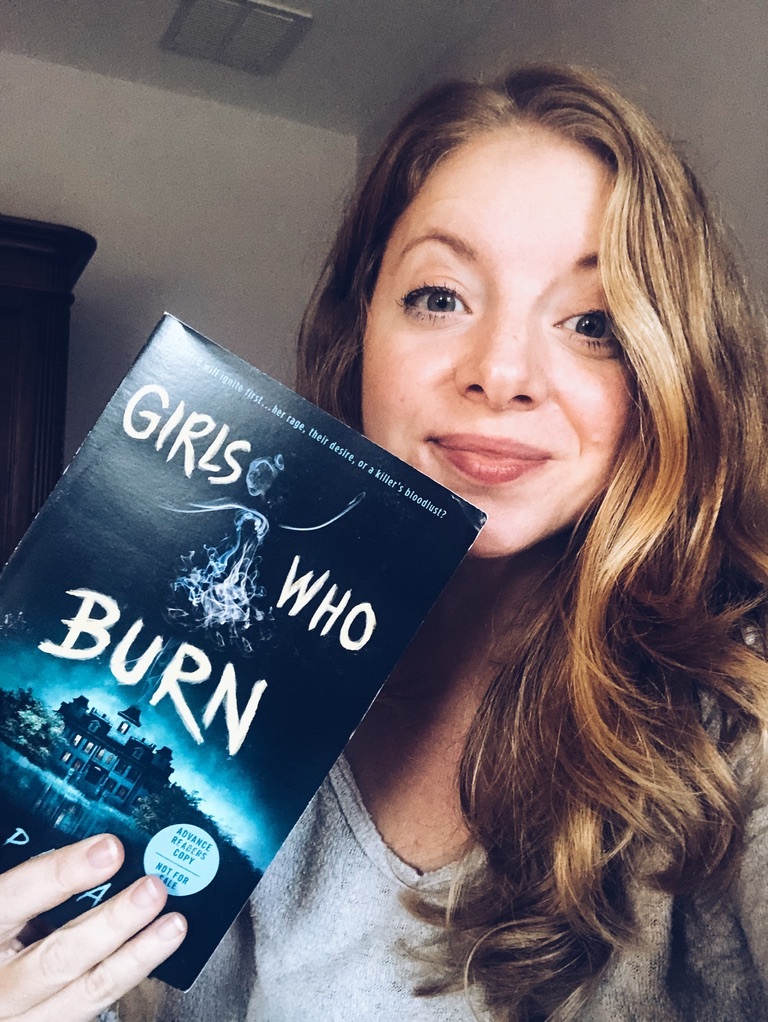
This week we have MK Pagano, who I know via an online group for debut authors. MK lives in New Jersey, in the US, and her YA thriller Girls Who Burn will be out in July. You can pre-order it here.
Why did you pick traditional book publishing? Why not self-pub or even some other art form, to tell this story? Interpretive dance, perhaps? A computer game? A series of sculptures? Why a novel, with a publisher?
I’ve always loved writing, and I have never had great coordination, so that’s why no interpretive dance. I assume my love of writing came from my love of reading, as it has for many people—I adore a written story, and therefore I decided to create my own. I’ve been writing since I was a little kid. I stopped in high school because none of the cool kids wrote down weird little stories in their spare time, started again after college when I finally realized that I could do what I wanted, regardless of what the cool kids were doing.
Why trad pub? To be honest, I never even considered self-pub seriously. Firstly, I wanted all the bells and whistles: the professional editor, the cover artist, the retailer reach, the marketing plans. I have no desire to do any of that entirely on my own; I don’t have the time. Secondly, honestly, I wanted the clout: to say my book was coming out from a major publisher, and you can find it wherever books are sold. It took me six books to get here, but I figured one of these times I’d write something good enough to get snapped up. I think patience, persistence, and as always, luck, were the keys here.
Why this genre? Why this age group? Why these characters?
I started out writing various genres of YA: I have a speculative mystery, a fantasy, and three contemporaries on my shelved books bookshelf. I wrote a thriller this time because my book that died on sub last time, which I thought was a contemporary but did involve a missing girl, kept getting called “too quiet for a thriller,” which was news to me, as I didn’t think I’d written a thriller. I was a huge thriller reader, I just never thought it was something I’d be able to pull off as a writer. But as I’d written multiple contemporaries and none of them had gotten me published, I thought, well, let me give it a try. And so I did!
As for why YA, it’s just always what I’ve been naturally drawn to. I love the in-between, uncertain periods of life, I think that’s where the most interesting things happen to most people, and there’s nowhere more in-between or uncertain than adolescence. Things are changing so fast for you, from your peers to your desires to your own body, it’s really hard to know with any certainty what you’re doing or even who you are. I love the way teens think, how capricious they can be, how volatile. I’m not interested in writing stable, calm, rational characters; I want ones who are doing their best but make mistakes, have big emotions, lash out.
I also love writing about firsts: first kisses, first loves, the first time you figure out your parents aren’t infallible. There’s a uniqueness to the teenage years I don’t think you can find at any other life stage, except perhaps the early twenties, and New Adult is still kind of a no-man’s land in trad pub (though the moment that improves, you’ll find me writing there, too). I have tried my hand at writing adult a few times, but I always, always end up making it dual-timeline, and in the earlier timeline, the characters are teens, hahaha. I can’t escape what I want to write, no matter how hard I try.
As for why these characters? I’m not sure they ever gave me the choice! Going into this story, I knew my protagonist, Addie, was angry and volatile, and I knew it stemmed from a deep self-loathing that I had to tap into to figure out how she ticked. So I figured out why she had such self-loathing (her “misbelief”—thank you Story Genuis). The next character to figure out was Seth, her co-investigator and on-and-off love interest. I knew these two had a big history, and I know he had to be someone who could go toe-to-toe with Addie and hold his own, not an easy feat. I also knew they’d have some fundamental differences that contributed to their antagonism, which is where the wealth gap came in.
After I had those two down, populating the other characters was a little easier, though you always have to be careful as a writer to make each character fully-formed in their own right, and not just there to serve the story or the two mains. So I write little backstories for each one, make sure that every scene they’re in, they’re pursuing their own desires, not just reacting to what the main characters are doing. Character work is one of my favorite parts of writing, and it always warms my heart when people seem to notice and appreciate the work I put in there.
Was it a long road to get here? Do you have drawers full of previous manuscripts?
Oh, YES. I started writing “seriously” over ten years ago. My first book took me five years to finish, and the most important thing about it is that I made ALL the mistakes with it, and learned from them. My second book I drafted faster, in under a year, and I actually secured an agent with that one. This is the one that died on sub, though, and afterwards, my first agent and I parted ways; she couldn’t connect with anything else I’d written. Between sub rounds of that book, I’d drafted two more YA contemporaries and a fantasy, but I think in a way I knew she was right about one thing: none of these books had much of a chance of being published. So I figured I could mess around revising, or try something new, and all those “too quiet for a thriller” rejections were ringing in my head.
So the next book I wrote, my sixth book overall, was Girls Who Burn. I had to query again, which was slower this time, post-pandemic, but at the end of it, I ended up with four offers of rep! I adore the agents I chose in the end, and actually from that point on, things moved fast; we revised together in under a month, and I was on sub for only two weeks before my book sold in an exclusive to Penguin Teen. After over a decade of hoping for and working towards this, it was absolutely surreal to have it finally happen.
How nervous are you, on a scale of 1-10 (I’m currently sitting at 4) and how are you dealing with that?
I would say like a 6? I know I wrote a great book; it still feels weird and conceited to say it, but it’s true: this is the best book I’ve ever written, and I think it’s great. Early reviews have backed me up—they’ve been incredibly, overwhelmingly positive (and yes, I know we’re not supposed to read them, but how can I not?). So I guess my nervousness is just around everything that’s out of my hands. I know that publishing is not a meritocracy, that you can write an amazing book and still not have it make a big splash, and it’s not like I’m aiming for number one bestseller here, but I will be incredibly disappointed if this book does not do well, whatever “well” means for the kind of book I wrote.
I have some confidence it will do well, as I’ve had some foreign rights interest (the UK is the only one announced right now, but there’s more to announce soon, I hope) but there’s always a chance it could flop, and flop hard, and there will be nothing I can do about that. All I know how to do is write a great book, and if it doesn’t reach its readers, I don’t think that will be on me. Trying to focus on what is in my control—writing another great book—is how I’m dealing for the most part. Whenever this business gets to be too stressful and too much, I retreat back to the part I’ve always loved, the part that is always there for me: the writing itself.
What’s next?
Another YA thriller is in the works! I can’t say a ton about it yet, but just know this is both the fastest I’ve ever drafted something, and it also has me excited about all the ways it’s different from my debut. It’s funny, with your second book you want something that’s “the same but different,” and the first time I heard these words, I was left nearly crying: what does that mean? But I think I’ve figured it out.
I started with a brand-new setting—I always start with setting, I love a well-drawn, unique setting—and then figured out my main character, and made sure she was different from Addie in significant ways. The murder has to be different; so do the motives and the main themes. But then, no matter what I do to differentiate it from my debut, it’s still going to be a “me” book—there’s no way around that. So that’s where the “the same” part comes in. There’s still some commentary on the wealth-gap, though it’s not as heavy-handed as in my debut; there’s still first loves and insecurity; there’s still a close-knit small-town feel.
I don’t think I really have to worry about anything I write not being “on brand,” because my “brand”—which is really just me—comes through, like it or not.
Most writers on their path to publication think about giving up at some point. Was there anything that made you feel this way? What kept you going?
Honestly, I don’t think giving up entirely was ever something I seriously considered. Writing is like therapy to me; it gives me a reprieve from my everyday life, from the real problems that have plagued me over the years; it’s my escape hatch. And yes, I always wanted my stories to turn into real books someday, put out by a real publisher, and there were definitely times I felt frustrated or thwarted along the way, definitely times I picked up a published book and got pissed because I knew I could do it better. But I think most of the time, I knew I just had to keep going.
There was a time, early on in my corporate career, when writing and querying my first (bad) book, that I got my hopes up, thought that if I could just get a book deal, I could quit my day job and finally be happy. Once that illusion shattered, I kind of just kept on going. I learned that very few authors get to quit their day jobs, realized that one book deal was not going to be the magical thing that fixed all my problems, and went back to treating writing like the thing it was: something I loved to do. Sometimes I lamented not starting sooner—I was twenty-five when I started my first book, hadn’t attempted to write any fiction since I gave it up at fourteen—but honestly, I think being a little older and more mature when the setbacks came helped me out a lot. As a teen or even in my early twenties, I would have been devastated at every turn, but as an actual adult, I was able to put it all into perspective. Having patience helps tremendously in this industry, and it was not one of my strong suits when I was younger.
 Lisa Tirreno