On the Cusp is a regular series I do on this blog, comprising an interview with another writer who’s about to become a debut novelist. I send them the standard list of ten questions and ask them to please pick five, and to also answer the bonus question.
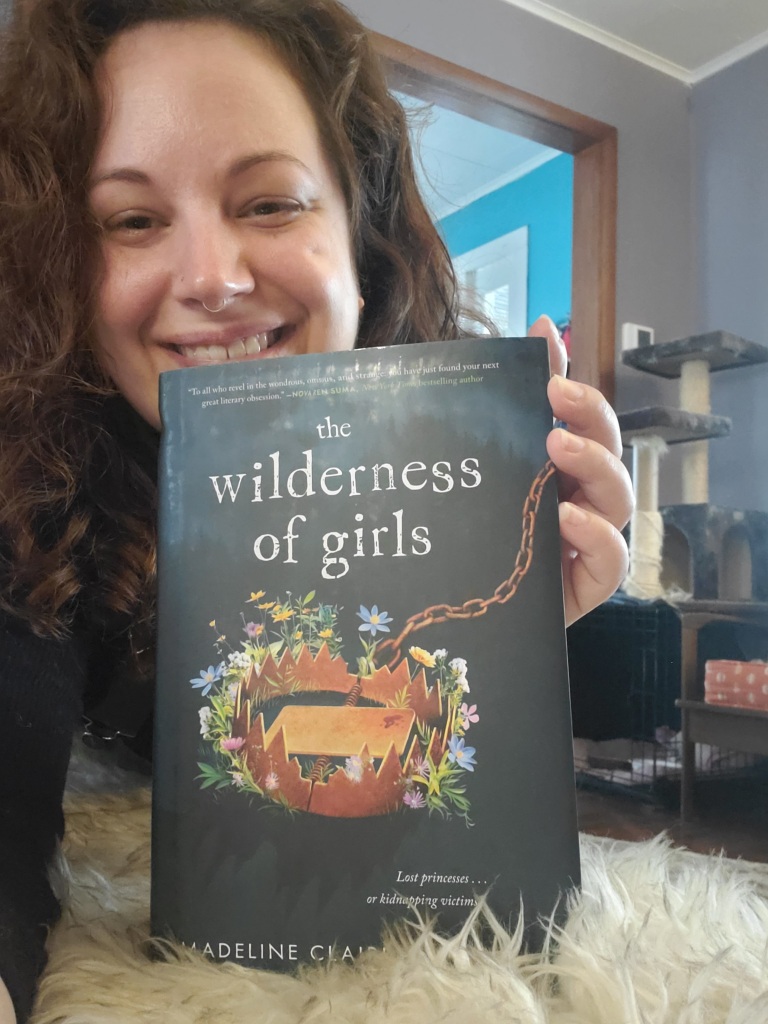
This week we have Madeline Claire Franklin, who I know via our 2024 debut authors group. Madeline lives in Buffalo, NY, and her young adult novel The Wilderness of Girls will be out in June. Pre-order links are available here.
Why this genre? Why this age group? Why these characters?
I’ve always written YA, even if I didn’t know about YA as an age category until I was already an adult. But specifically for this book, which is about how the mores of Western civilization often contribute to shaping young girls into pliable victims, the story had to be for teens and about teens. Teenagerdom is an endless series of crossroads. You’re defining your identity and values, choosing your life path, building the foundation of the adult you’ll become. The main characters in The Wilderness of Girls embody that experience, even though four of them have lived half-feral their entire lives—those characters get the unique experience of being aware of the social conditioning people are trying to push on them, and are able to question it and push back with intelligence and awareness. And the main character Rhi (the “normal” girl) was initially written as an avatar for the reader—a way to explore the lives of the wild girls in a context the reader would relate to—but then became someone much more real and alive than I’d originally been ready to write.
It took me over six years to finish this novel, and figuring out Rhi was part of the reason why. I had to face my own complex-PTSD in order to unlock her. Once I did, I finally realized the part Rhi needed to play, and why the story of the Wild Girls couldn’t be complete without her.
What’s surprised you the most during this whole pre-publication process? What have you enjoyed the most?
Honestly, what surprised me the most was how quickly the goalposts moved (and keep moving). I spent my entire life yearning to be a traditionally published author, so when I first sold my book in January of 2023 it seemed like all my dreams had come true and I would never have a reason to be unhappy ever again (not actually, but I did spend a long time wondering who I was if I wasn’t yearning anymore). And I really did milk that victory for a long time! But as soon as we started selling foreign rights, I wanted to sell more foreign rights. We got a film and tv agent, and I’m low-key disappointed we haven’t optioned dramatic rights yet (partly because in my mind this would make an amazing TV series–there is so much that never made it into the book that would make for excellent TV!).
My reviews are pretty stellar so far, but sometimes I look at others who are also debuting in June and think I don’t have enough reviews. Various book lists for 2024 started coming out late last year and since then, as far as I know I’ve only been on one very niche list, and somehow that feels like a personal failure (it’s not). I am constantly reminding myself “I’m just happy to be here” in order to fight off this weird feeling of failure before the book is even out. I remember in my pre-book-deal days seeing published authors complain about things online and feeling really annoyed: Don’t you know how lucky you are?! I obviously also understood that priorities and desires change once you get to this stage, but I couldn’t help that feeling. Now I’m here, complaining that I’m not featured on any “most anticipated” lists, but I’m still shouting that in my head: Don’t you know how lucky you are?
I think it’s human nature, though. We have to keep moving the goalposts, otherwise we’d stagnate. But these little things like making most anticipated lists aren’t really goals, because I have virtually no control over them. Of course I want my book to do well (what does “well” even mean, though?), but I do have to remind myself that I’m in the process of achieving my life’s dream, and it was a huge one. Now I need to find another huge dream to shoot for, not these quick little validations from strangers on the internet–something I’m actually somewhat in control of. I’m not in control of whether or not we option TV rights, Hollywood is. But I’m in control of the next book I write, and the next. And I’m in control of how I parlay my (hopeful) success into other writing-adjacent ventures. Maybe the next huge dream is the rest of my career.
The thing I’ve enjoyed the most is hearing from readers that, more or less, I accomplished what I set out to do when I started writing this book: tell a story that helps people feel seen and helps them heal. My biggest fear when I’m writing has always been that no one else is going to “get” what I’m writing (not in an elitist way, but in a neurodivergent way—and I started this book over six years ago, well before I had any inkling that I might be neurodivergent). The main question I had for my first beta reader on this book was “does it even make sense???” And it did. It needed work, but it made sense. Now, with the book finished and gone to print, I’ve heard from multiple readers some variation of “this book tore me apart and put me back together again” and if that’s not the ultimate goal of being an author, I don’t know what is.
What do you wish you’d understood better beforehand, about the business?
That it’s okay to push back on editorial feedback as long as you can explain why. Editors aren’t better than authors at telling stories (though they are story magicians if you ask me). They’re partners helping you corral the hundreds of moving parts that make up a book. Most of the time, yes, they’re probably right, but if you don’t agree with them you don’t have to sweat about it. They’re not going to cancel your book because you said “no, I want to keep this scene.” They won’t even take it personally! And boy did I sweat about that each time a new round of edits came back.
Also, copyeditors: they’re not telling you that you must change something otherwise you’re perpetuating the downfall of English grammar, they are just letting you know that maybe you’re not being grammatically correct, or there’s a tiny potential for misunderstanding. They’re basically the Devil’s advocate and the grammar police. They will find a lot of things you should probably change, but they’re also going to suggest your metaphor about ghosts would technically be better suited to zombies, even if that totally ruins the poetry of the sentence, and it’s 100% ok to “stet” that and ignore their advice.
How nervous are you, on a scale of 1-10 (I’m currently sitting at 3, today) and how are you dealing with that?
To be very honest, I’m not nervous at all about actual publication. I think, after spending most of my life daydreaming my way into authorhood, I’m actually kind of prepared for this part. (Except for public events. I am just not thinking about those any more than I have to.) What has me on edge these days is working on the next book, which is technically already sold, but a fun thing about that is it doesn’t actually make it any easier to write. And this is the first time I’m writing a book from scratch with people basically looking over my shoulder, which is A Lot, emotionally and psychologically. I’m used to writing in solitude for a few years, until I have a pretty polished draft to show, and already have a good idea of the story’s weaknesses and strengths. But now I’m under contract (hooray!) and thinking things like “don’t screw this up!” (boo!) which is frankly unhelpful when you’re trying to entice the Muses to come sit with you.
Knowing me, though, come June 11th, I’ll be vibrating with anxiety at about a 9.9.
What’s next?
I can’t say too much yet, but the second book on my contract is another standalone YA. This one is about the far-reaching power of mythology, witchcraft, what real justice in sexual assault looks like, and the men’s self-help-to-black-pill/radicalization pipeline. It deals with a lot of heavy stuff, but it’s also (I hope) cathartic.
And honestly? I’d also love to parlay any success with The Wilderness of Girls into teaching ventures, possibly writing retreats/workshops or other creative writing instruction opportunities, but I have a lot to learn on the business side of things before I can do that (and unfortunately I still have a day job that takes up a lot of my time).
Aside from that, I’ll be among the authors at The Bronx Book Festival in June, and that Monday (June 10th) we’ll be having The Wilderness of Girls book launch at Books of Wonder in NYC. All are welcome! There may be s’mores (I’m working on it). We’re also having a hometown launch event at Talking Leaves in Buffalo, NY on June 20th.
Bonus question: Most writers on their path to publication think about giving up at some point. Was there anything that made you feel this way? What kept you going?
There was never a point at which I actually felt like giving up, but there were plenty of times when it felt hopeless. Like I mentioned above, I have been neurodivergent my whole life without knowing it, which can make you feel like a total alien, which can then make it feel like you are “too weird” to succeed in an industry that relies on your work speaking to as many people as possible. Luckily I had a lot of support along the way, in friends and family and my graduate school community, constantly upholding the truth I knew in my bones: I am a storyteller, and words are my medium.
Besides that, I am far too stubborn to ever give up. What kept me going when things got tough was often spite at the Universe, but also a strange resignation to the fact that I knew I would always keep chasing this dream no matter how many times my failure to achieve it beat me down (just as I still know I will always want to write stories no matter how hard things get).
Also, and importantly, there have been so many times in my own life when I’ve come across a book that never made any lists, that no one is talking about, that maybe even has bad reviews, and it has changed or touched me in a way no bestseller has in years. Those books are important, too. I would be honored to be that book for someone else.
Also, therapy helps a lot.
For more information, visit madelineclairefranklin.com.
 Lisa Tirreno